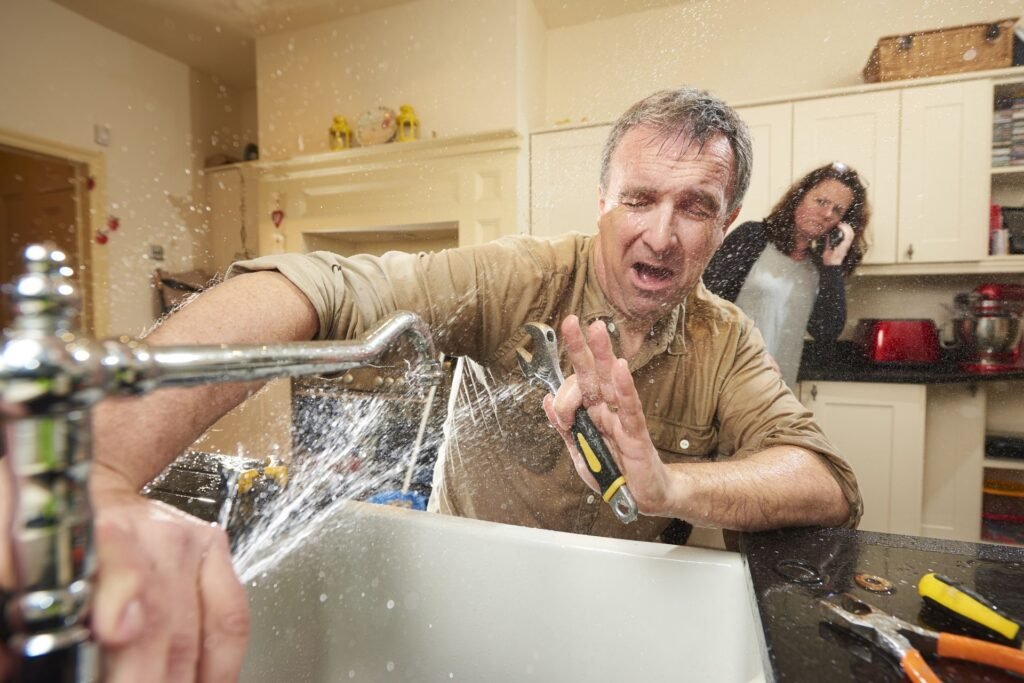
A bad drain problem rarely stays small for long. What starts as a slow sink, a bad smell outside, or water backing up around a gully can quickly turn into property damage, hygiene issues and a lot of disruption. That is why drain repair methods explained in plain terms can help you make a quicker, better decision when something goes wrong.
For homeowners, landlords and businesses, the main question is usually not whether a drain needs attention, but what kind of repair is actually suitable. The right answer depends on the cause of the fault, the condition of the pipe, how accessible it is and how urgent the problem has become. Some drains can be repaired with minimal disruption. Others need a more direct replacement to stop repeat failures.
Drain repair methods explained – what affects the choice?
Before any repair is chosen properly, the fault needs identifying. A blocked drain is not always a damaged drain, and a damaged drain is not always a full replacement job. Tree root ingress, fractured joints, corrosion, ground movement, scale build-up and collapsed sections can all cause similar symptoms, but the repair approach may be very different.
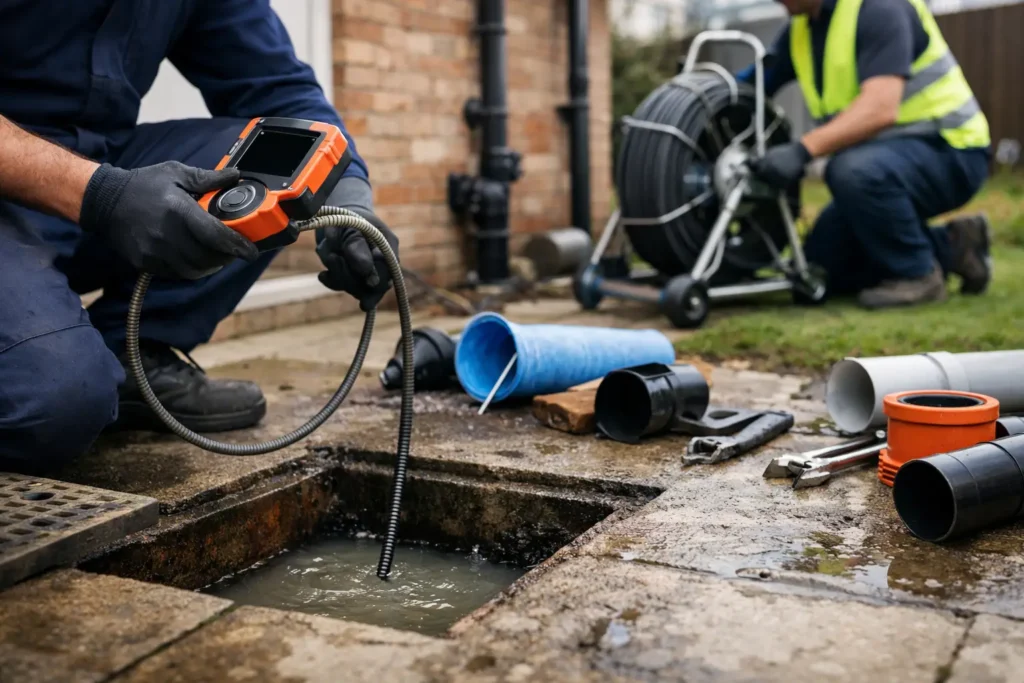
This is why inspection matters. In many cases, a CCTV drain survey is the most practical way to see what is happening inside the pipework. It shows whether the issue is a local crack, an open joint, a displaced section or a wider structural failure. For occupied homes, rental properties, cafés, schools or offices, that matters because unnecessary excavation creates cost and disruption that may not be needed.
The age of the drainage system also plays a part. Older pipework may have multiple weak points, so fixing one area alone is not always the best long-term option. On the other hand, a newer system with a single damaged section may be a straightforward repair.
Localised patch repairs
A patch repair is often used when the damage is limited to one small section of pipe. This might be a crack, a joint defect or root ingress affecting a short area rather than the whole line. The repair usually involves installing a resin-impregnated patch into the damaged section, which is then set in place internally.
The big advantage is reduced disruption. If the defect is isolated, there may be no need to dig up large areas of flooring, paving or landscaped ground. For busy homes and commercial premises, that can be a major benefit.
Patch repairs do have limits. They are not a cure for a drain that is failing in several places or has lost its shape through collapse. If the surrounding pipe is already in poor condition, a patch may solve one problem but leave others waiting. Used in the right situation, though, it is a quick and cost-effective option.
Drain relining
Drain relining is one of the most commonly used repair methods where a pipe has cracks, minor fractures, leaks or root ingress, but still has enough structure left to support a liner. In simple terms, a new lining is inserted inside the existing drain, creating a smooth internal surface and sealing defects.
This method is popular because it is far less invasive than excavation. It can often be completed with minimal disturbance to patios, driveways, internal floors or trading areas. For landlords and property managers, that can mean less inconvenience for tenants and fewer complaints about disruption.
There is a trade-off. Relining slightly reduces the internal diameter of the pipe, although in most cases this does not cause a practical problem. More importantly, relining is only suitable if the original drain has not fully collapsed. If the pipe is badly deformed or blocked by heavy displacement, it may need a different approach first.
Excavation and full section replacement
Sometimes the most sensible repair is the one people hope to avoid. If a drain has collapsed, dropped significantly, or suffered major structural damage, excavation and replacement may be the only reliable option. The damaged section is exposed, removed and replaced with new pipework.
This is more disruptive than internal repair methods, but it is sometimes the strongest long-term fix. If a drain has repeated failures in the same area, or if the pipe has been crushed by ground movement or heavy loading, relining may only mask a deeper issue. Replacing the section deals with the structural problem directly.
For some properties, access is the biggest challenge. A drain under a driveway is one thing. A drain beneath an extension, commercial kitchen area or heavily used access route is another. In those cases, the repair needs careful planning so the work is safe, tidy and completed with as little disruption as possible.
Root removal and root ingress repairs
Tree roots are a common cause of drain trouble, especially in older systems with small cracks or loose joints. Roots do not usually break into a sound pipe for no reason. They find an existing weakness, then expand inside the drain where moisture is present.
Cutting out the roots may restore flow, but that is not always the end of the problem. If the point of entry is left open, the roots often return. That is why proper repair usually means both removing the obstruction and sealing or repairing the damaged area.
Depending on the severity, that may mean a patch repair, relining or replacing the affected section. It depends on how far the roots have spread and whether the pipe walls are still structurally sound.
Joint repairs and connection issues
Not every drain defect involves a visible collapse. Sometimes the issue is at the joints, where sections of pipe have shifted, opened or started to leak. This can allow water to escape into the surrounding ground and let soil or roots enter the system.
Joint problems can cause repeated blockages, bad odours and slow drainage, particularly if waste catches on rough or uneven internal edges. In some cases, a localised internal repair is enough. In others, if the joint displacement is significant, excavation may be needed to realign and replace the affected section.
This is a good example of why a quick unblock is not always a full solution. If the same drain keeps backing up, there is often an underlying fault that needs repairing, not just clearing.
When drain cleaning is not enough
A lot of customers first notice a problem when a sink, toilet or outside drain starts draining slowly. It is natural to assume the answer is simple cleaning, and sometimes it is. Grease, wipes, scale and debris can all cause restrictions that respond well to professional drain clearing.
The problem is when cleaning restores flow temporarily but the same issue comes back. Repeated blockages in the same area can point to pipe damage, poor alignment, a belly in the pipe run, root ingress or a partial collapse. If the symptoms keep returning, further investigation is usually the sensible next step.
Acting early can save a lot of money and disruption. A small crack or failed joint is far easier to deal with than a fully collapsed drain that has started affecting floors, walls, external surfaces or neighbouring areas.
Choosing the right repair for your property
The best drain repair is not automatically the cheapest or the least disruptive on paper. It is the one that solves the actual fault properly. For a homeowner, that may mean avoiding repeat callouts and water damage. For a landlord, it may mean keeping tenants safe and reducing complaints. For a restaurant, café, hotel or school, it may mean protecting hygiene standards and keeping the premises operational.
A practical repair decision usually comes down to five things: the extent of the damage, how easy the drain is to access, whether the issue is isolated or widespread, how urgent the situation is, and whether the repair will genuinely last.
That is also why honest advice matters. Some drains can be repaired internally with very little disruption. Others need excavation, and delaying that can make the eventual problem worse. Clear communication at this stage helps customers understand what is necessary and what is not.
Drain repair methods explained for urgent situations
If wastewater is backing up, there is a strong drain smell indoors, water is surfacing outside, or toilets and sinks are becoming unusable, it is best not to wait and see. Drain faults can escalate quickly, especially in occupied properties where daily use continues. The longer the system struggles, the greater the risk of internal damage, contamination and disruption.
For businesses, the stakes are often even higher. A blocked or damaged drain can affect staff facilities, customer areas, food preparation spaces and general trading. For rented properties, delays can create avoidable stress for both tenants and landlords.
If you need clear advice and a practical repair solution, HJZ Plumbing can help identify the problem and recommend the right next step without overcomplicating it. For fast, reliable support, call 01482 236483 or contact us through www.hjzplumbing.com. Getting a drain checked early is often the simplest way to protect your property from a much bigger repair later.