A leaking meter box on the drive, a cracked cover outside the boundary, or a sudden spike in your bill can leave you asking the same question in a hurry – who is responsible for my water meter? The answer is usually straightforward, but not always. It depends on where the meter is, which part is damaged, and whether the issue is with the water supplier’s equipment or your own pipework.
For most properties, the water company is responsible for the meter itself. That normally includes the meter body, the connections immediately around it, and often the external chamber or box if the meter is fitted outside. If the meter is faulty, unreadable, damaged through age, or suspected of recording incorrectly, that is usually one for your water supplier.
Where people get caught out is assuming that everything near the meter belongs to the supplier. It does not. In many cases, you are responsible for the pipework that runs from the meter into your property, especially once it serves only your home or premises. If that pipe leaks, freezes, bursts, or starts affecting water pressure, the repair is often down to the property owner.
Who is responsible for my water meter and nearby pipework?
A simple way to look at it is this. The supplier generally owns and maintains the meter. You generally own and maintain your internal plumbing and, in many situations, the supply pipe that carries water from the meter to the building.
That means responsibility is usually split between two parties. If the problem is with the measuring device, the stop tap fitted by the supplier, or the chamber housing an external meter, contact the water company first. If the problem is a leak after the meter, low pressure caused by internal restrictions, or damaged pipework within your boundary, you will usually need a plumber.
There are exceptions. Some older properties, converted buildings, and commercial sites have less obvious layouts. Flats may share incoming supplies. Shops, schools, cafés and other occupied premises sometimes have meters in service cupboards, shared plant areas or external chambers serving multiple units. In those cases, ownership and repair responsibility can be less clear, and it is worth confirming before anyone starts digging or replacing parts.
Where the meter is makes a big difference
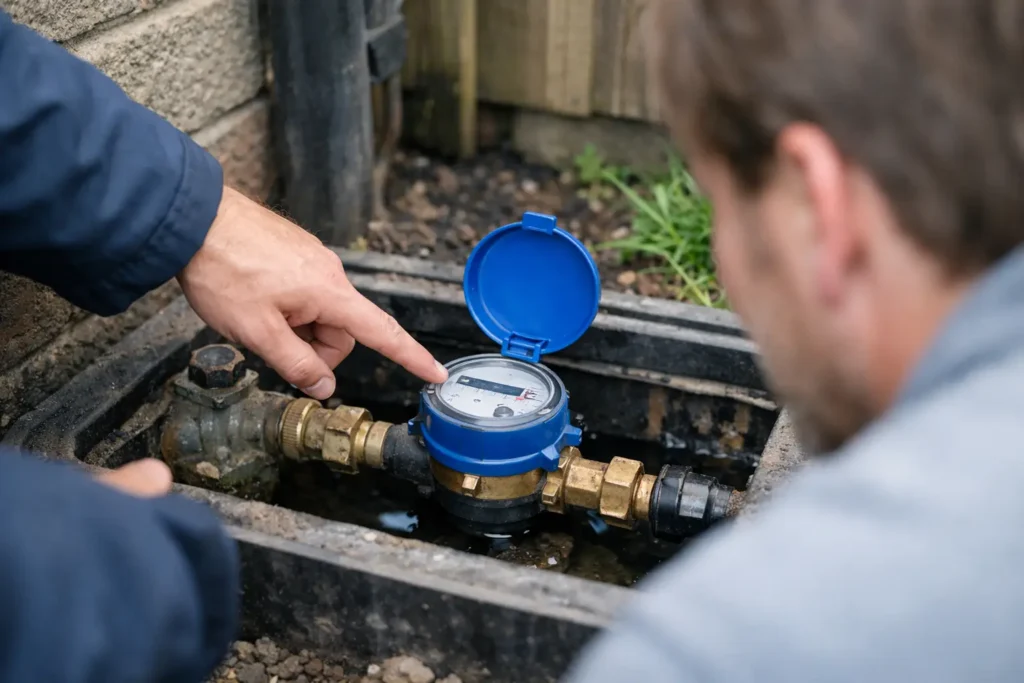
If your water meter is outside, often in the pavement or near the boundary of the property, the supplier is usually responsible for the meter itself and the chamber. This is the most common arrangement for newer metered properties.
If the meter is inside, perhaps under the kitchen sink, in a utility room, cellar or service cupboard, the supplier still usually owns the meter. Even so, the pipework, fittings, and any leaks around the surrounding plumbing may still be your responsibility. A dripping connection near the meter is not always a meter fault. It may be a joint on your side that needs attention.
This is why location matters, but it is not the whole story. Two leaks can appear to be in exactly the same place while falling under different responsibilities. One may be a failed supplier fitting. The other may be a split on the property’s incoming pipe.
The usual dividing line
In plain terms, the dividing line is often the point where the water supply starts serving only your property after passing through the meter. Before that point, it is normally the supplier’s side. After that point, it is usually yours.
For homeowners, this often means the underground pipe from the meter box to the house is privately maintained. For landlords and commercial operators, it can also include pipework feeding toilets, kitchens, washrooms, staff areas, and customer facilities once the water has entered the premises.
Signs the problem may be the water company’s responsibility
If the meter display is blank, damaged, misted up, or clearly broken, that is usually for the supplier to inspect. The same applies if the chamber lid is unsafe, the meter appears to be physically cracked, or there is water visibly rising from the meter housing itself.
Another clue is an unexpectedly high bill without any signs of leakage inside the property. A hidden leak on your side is still possible, but a faulty meter is not impossible. The water company can test or inspect the meter if there is reason to believe readings are inaccurate.
If the stop tap operated by the supplier has seized or failed at the boundary meter chamber, report it. That is not usually something a private plumber should alter without approval.
Signs the problem may be your responsibility
If you have damp patches, poor pressure, noisy pipework, water staining, or a persistent leak inside the building, that is usually your side of the system. The same goes for underground leaks between the meter and the property, which can be harder to spot at first.
One common sign is the meter continuing to move when no water is being used inside. If all taps and appliances are off and the meter is still ticking over, there may be a leak on your supply pipe. In that case, the meter may be working perfectly well – it is just revealing a problem that needs fixing.
For landlords, this matters because a hidden supply pipe leak can lead to tenant complaints, water damage, mould risk and unnecessary cost. For businesses, it can mean disruption to toilets, kitchens, handwashing points, or customer facilities. Waiting too long can turn a manageable repair into a much larger job.
What to do if you are not sure who should fix it
Start by checking where the leak or fault appears to be. If it is clearly on the meter or in the external meter chamber, contact your water supplier. If it is on pipework entering or within the building, contact a plumber.
If the cause is unclear, take a few practical steps. Note whether the meter is still moving when no water is in use. Check for visible water around the chamber, path, drive, floor or wall where the supply enters. Look for a sudden drop in pressure or signs of continuous dampness. These details help narrow things down quickly.
In some cases, you may need both parties involved. The supplier may confirm the meter is sound, while a plumber investigates the private supply pipe or internal plumbing. That split approach often gets to the answer faster than waiting and hoping the problem settles down.
Do not leave it too long
A small external leak can wash out ground beneath paving. A hidden internal leak can damage floors, units, plaster and ceilings. In commercial settings, water issues can affect hygiene, staff welfare and customer experience very quickly. Early action nearly always keeps the repair simpler and cheaper.
What about shared supplies and rented properties?
In rented homes, the responsibility for private pipework and plumbing repairs usually sits with the landlord or managing agent, not the tenant. The tenant may be responsible for reporting the issue promptly, but not for repairing the incoming supply pipe.
With shared meters or converted buildings, the position can be more complicated. If multiple flats or units are fed from one meter, responsibility for downstream pipework may sit with the freeholder, management company or landlord rather than an individual occupier. For mixed-use properties and commercial premises, the lease can also affect who pays for what.
If there is any uncertainty, check the tenancy agreement, lease, or management arrangements alongside the supplier’s guidance. It saves time and avoids delay when a repair is urgent.
When to call a plumber
Call a plumber when the issue appears to be after the meter, when water is escaping into or under the property, or when pressure, flow or internal fittings are affected. That includes hidden leaks on the incoming main, damaged internal stop taps, split pipes, failed joints and water damage linked to the supply entering the building.
A practical plumber can also help you work out whether the fault is on your side before unnecessary time is lost with the wrong party. For homes and businesses across Hull and the surrounding area, HJZ Plumbing helps identify leaks, trace supply problems and carry out tidy, reliable repairs before a minor fault becomes major damage.
If you are dealing with a suspected leak, unexplained meter movement, damp around the incoming supply, or plumbing trouble linked to your water meter, get it checked promptly. Call HJZ Plumbing on 01482 236483 or visit www.hjzplumbing.com to arrange help. Clear advice early on can save a great deal of cost, mess and disruption later.